| The Department of Electrical and
Systems Engineering (ESE) at the University of Pennsylvania is a
leader in the areas of Electroscience, Systems Science, Network
Systems and Telecommunications.
NEW FACULTY
Rahul Mangharam, Assistant Professor of Electrical and Systems Engineering, PhD in Electrical & Computer Engineering (2007), Carnegie Mellon University.
Dr. Mangharam's interests are in sensing, communication and actuation between the physical and virtual worlds. His focus includes scheduling algorithms for wireless and embedded systems for time-critical and safety-critical applications. His research spans both hardware and software system design, algorithms and large-scale deployments. He is currently working on wireless sensor networks for medical care so people can age gracefully. He also designs protocols for vehicle-to-vehicle networks with the goal of making driving safer, more efficient and, of course, more fun.
In 2002, Dr. Mangharam was a member of the Ultra-Wide Band Wireless Group at Intel Labs. He was a visiting researcher at the Athens Information Technology, Greece in the summer o 2006 and in the Institute for Information Industry, Taiwan in 2005. He was an international scholar in the Wireless Systems Group at IMEC, Belgium in 2003. He has worked on ASIC chip design at Marconi Communications (1999) and Gigabit Ethernet at Apple Computer Inc (2000).
André DeHon, Associate Professor of Electrical and Sytems Engineering, PhD in Electrical Engineering and Computer Science from MIT; Post-Doc at UC Berkeley and former Faculty member at CalTech.
Dr. DeHon's research addresses how we efficiently engineer systems which implement computations. His recent areas of focus include reconfigurable computer architectures, nanoscale computation including molecular electronics-based programmable logic, and interconnect design and optimization. His work in computer systems spans from transistors to applications including computer architecture, VLSI, parallel computation, compilation and mapping technology and operating and run-time systems. Broadly, he works to understand and characterize the computational requirements of tasks, the cost landscape for physical implementations and the design space for mapping logical computation efficiently and robustly into physical realizations.
Cherie R. Kagan, Associate Professor of Electrical and Systems Engineering, PhD in Materials Science and Engineering and Electronic Materials from MIT.
Dr. Kagan joined Penn Engineering in January 2007 from IBM T.J. Watson Research Center where she was a Staff Researcher and Manager of the Molecular Assemblies and Devices Group. Her research was in the area of molecular electronics. Her work has demonstrated that organic-inorganic hybrid materials can be utilized as an alternative class of semiconducting channel materials for thin-film transistors.
Gianluca Piazza, Assistant Professor of Electrical and Systems Engineering, PhD in Electrical Engineering and Computer Science from UC, Berkeley.
Dr. Piazza's research focuses on piezoelectric micro- and nano- systems (MEMS/NEMS) for RF wireless communications, biological detection, wireless sensor platforms and medical ultrasounds with general interest in the areas of micro/nano fabrication techniques and integration of micro/nano devices with state-of-the-art electronics.
NEWS
Penn's Autonomous Car "Little Ben" Advances to the Finals of the DARPA Urban Chalenge -- Under the team leadership of Professor Daniel D. Lee, "Little Ben", the autonomous vehicle engineered by the University of Pennsylvania and Lehigh University faculty and students to drive itself, has advanced to the finals of the 2007 DARPA Urban Challenge. The finals will be broadcast live on Saturday, November 3, 2007 at 11 a.m. EST at www.grandchallenge.org. For further information on "Little Ben", visit http://www.upenn.edu/pennnews/article.php?id=1252.
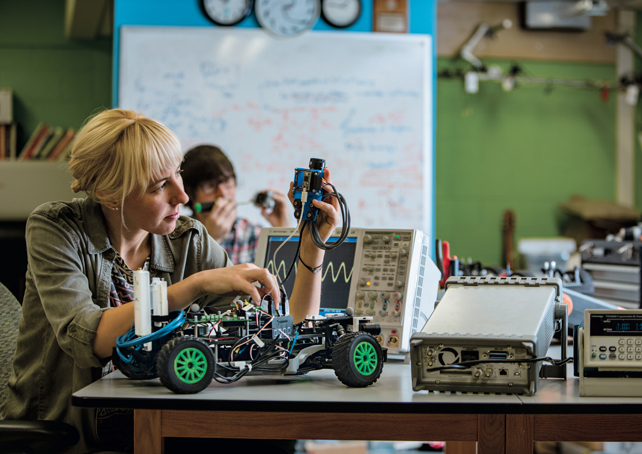
Prof. Daniel Lee inspiring students to make "real world" applications in ESE 350 Microcontroller Laboratory (See Page 19 in Penn Engineering News).
Prof. Roch Guerin has been named a Fellow of the Association for Computing Machinery for his contributions to the resource management of data networks. Guerin is among 41 ACM members recognized as 2006 Fellows for their work in the practical and theoretical aspects of computing and information technology. They represent some of the world's leading industries, universities, and research labs. ACM will formally recognize the new Fellows at its annual awards banquet on June 9 in San Diego. Additional information about the ACM 2006 Fellows and the awards event, as well as previous ACM Fellows and award winners, is available at www.acm.org/awards.
Prof. Nader Engheta has been named by Scientific American magazine as one of the 2006 Scientific American 50, the magazine’s annual list of leaders in science and technology. The list appears in the December issue, available on newsstands now. Engheta was cited for his research contributions in plasmonics, an emerging field of scientific inquiry regarding the optical and electrical properties of solid matter, such as metals, at nanometer scales. In writing about Engheta and his group’s research, George Musser from the Scientific American cites Engheta’s development of plasmonic versions of conventional electronic components, including resistors, capacitors and inductors that could allow engineers to build circuits at nanometer scales using light instead of electricity "The ‘current’ that flows around the circuit is not the motion of electric charges, but fluctuations in the electric field associated with the light,” Musser said. “One day soon, the fantastic world of plasmonics may be hanging from the rack at Radio Shack." Engheta is the H. Nedwill Ramsey Professor of Electrical and Systems Engineering and professor of bioengineering in Penn’s School of Engineering and Applied Science.
The magazine’s Scientific American 50 listing can be found at www.sciam.com.
RCA Lab Manager, Sid Deliwala, was recognized for creating an outstanding Electrical and Systems Engineering Lab. See Page 26 in Penn Engineering News
Brian Edwards, PhD Candidate in Electrical & Systems Engineering, has created electric tweezers that enable everyone to have a desktop lab. Click here to read article.
Prof. Barry Silverman's simulation research received extensive coverage in the September 2006 IEEE Spectrum article "Modeling Terrorists".
Gnana Bharathy (PhD ESE, 2006, Advisor: B. Silverman) was awarded the Stevens Doctoral Award for Promising Research in Systems Engineering and Integration. Along with the plaque and recognition at the Annual INCOSE Symposium, Dr. Bharathy received a $5000 grant.
Zhan Chen, Albert Ip, and Kejia Wu won first place honors in the SEAS Senior Design Competition held on Wednesday,
April 26, 2006. Their project was "Intellicam: An Intelligent Visual Tracking System" (Advisors: Jan Van der Spiegel
and Viktor Gruev). Honorable Mention awarded to Angelos Stamatakis, Jose Gabriel Ramos, Sendil Palani, and Vijay
Narasiman for "Encoding/Decoding System for PAPPA Experiment" (Advisor: Mark Devlin) and to Dong Tran and Michelle Kam
for "Pediatric Dynamometer" (Advisors: Jay N. Zemel and Babette Zemel).
Prof Nader Engheta was named the H. Nedwill Ramsey Professor of Electrical
Engineering (Sept. 2005). The H. Nedwill Ramsey Chair was established in The Moore School of Electrical Engineering through
the bequest of Mr. Ramsey, E'20, who had been a Penn Trustee and President of Philadelphia Electric Company.
Prof Ali
Jadbabaie was the recipient of the 2005 George S. Axelby
Outstanding Paper Award for the best paper published in the IEEE
Transactions on Automatic Control/ during 2003 and 2004 (winners are
chosen on "originality, potential impact on the theoretical
foundations of control, importance and practical significance in
applications, and clarity"). The awarding ceremony was held Dec. 14
in Seville, Spain, at the joint 44th IEEE Conference on Decision and
Control and European Control Conference ECC 2005 (CDC-ECC). The
winning paper, "Coordination of Groups of Mobile Autonomous Agents
using Nearest Neighbor Rules" [48( 6), 988-100 (2003)], was
co-authored by A. Jadbabaie, J. Lin, and Stephen Morse.
More
News...
|