

Doctoral Program
The Ph.D. program in Electrical and Systems Engineering (ESE) welcomes candidates with a strong background in science and engineering who are interested in pursuing an academic doctoral degree. The objective of this program is to help students develop skills needed to perform independent research and teaching in an exciting intellectual environment.
Our students work with world-class faculty advisors and mentors, and our research laboratories provide ample opportunities for students to work with other students and faculty to develop cutting-edge theories and technologies in collaboration with other departments and schools within the University. Click here for more information.
Apply here
Degree Requirements and Policies
Degree Roadmap
The ESE Ph.D. program is designed to provide sufficient structure to help students build a strong foundation, and to have sufficient flexibility to accommodate the direction of their creativity. PhD Candidates will collaborate closely with a faculty advisor on the direction of their research.
Starting in academic year 25-26, ESE PhD students are dual- enrolled in the Electrical Engineering (EE) Master’s program. ESE PhD students have the option to opt out of the master’s program or ask to earn a master’s degree in Systems Engineering (SE) or Robotics. Please contact your program coordinator, Nicole Contosta, for more information: contosta@seas.upenn.edu
Successful completion of the ESE PhD program requires the satisfaction of Benchmarks included in the Degree Roadmap below
| Benchmark: | Timeline: | Details: |
| Course Units (CUs): | Students are required to complete 10 CU’s. The ESE Department recommends that you complete your master’s degree by the end of your second year; however, please defer to the recommendations of your faculty advisor.
Students enroll in Research Units throughout the program |
10 CUs: Breadth (2), Depth (5), Critical Thinking requirements (2) Elective (1)
Note: ESE PhD students can apply the fulfilled EE master’s requirements to any of the depth, breadth, critical thinking, and elective requirements for the ESE PhD More information on how the EE master’s aligns with the ESE PhD can be found here 10 CUs of Research (ESE 9999): Students need to complete at least 10 but can register for additional research units. Students must register for 3 CUs to maintain full-time status. |
| Qualifying Exams: | Students must pass two qualifying exams by the end of the 2nd year.
Click here for the full policy on Qualifiers
|
Students can select any two of the following in consultation with their faculty advisor:
Nanodevices: ESE 5100 Electromagnetic & Optics (Fall); ESE 5210 The Physics of Solid- State Energy Devices (Spring) Circuits & Computer Engineering: ESE 5320: System-on-a-Chip (Fall); ESE 5720: Analog Integrated Circuits (Fall) Information Systems: ESE 5000: Linear Systems Theory (Fall); ESE 5300: Elements of Probability Theory (Fall) |
| Teaching Practicum (ESE 8950): | Students enroll in 2 teaching practicums after passing qualifying exams. This generally occurs in the 2nd or 3rd year | Prior to enrolling in the Teaching Practicum (TP), students participate in a 3-Day training course through The Center for Teaching and Learning (CTL) held prior to the start of the Fall Semester
All students, regardless of funding support or professional interests, must complete 2 TPs Placements are by faculty invitation. Or students can initiate. Students consult with their Faculty Advisor and contact their PhD Coordinator to register. TP does not count toward full-time status of 3 CUs. *Students are required to complete CTL Training (see below) before enrolling. *TA: students can apply for paid teaching assistant positions only after they have completed the 2 required teaching practicums. |
| Provisional Doctoral Committee: | Students generally select their committee by end of the 3rd year | The Department requires a minimum of three members for the Provisional Doctoral Committee. Submit in BP Logix(Form includes information on committee composition and option to invite outside faculty). Instructions:
|
| Candidacy Examination: | Students generally complete their candidacy examination at the end of their 3rd or 4th year | Students deliver a 45-minute oral presentation on a research problem and their ability to defend it. Prior to the exam, students submit a high-level proposal describing their research (3-page minimum).
The committee will review and advise on the research quality, potential, and ability of the student to perform the research as proposed. When the exam is completed and the students are approved for candidacy, students will submit the Candidacy Examination Form to their PhD Coordinator before entering the benchmark in BP Logix |
| Dissertation Defense: | This occurs in the last semester of your 5th or 6th year.
*Doctoral Time Limit students have 10 years after matriculating to complete their degrees. |
Students will register for ESE 9950 Dissertation their last semester
The Dissertation Defense Examination is a public, oral defense students’ research, and is administered by the dissertation committee, which will evaluate and approve by majority vote. See the detailed PhD Graduation Checklist for information on submission guideline For general information on Graduation Procedures Click here for more information on scheduling your dissertation/oral defense |
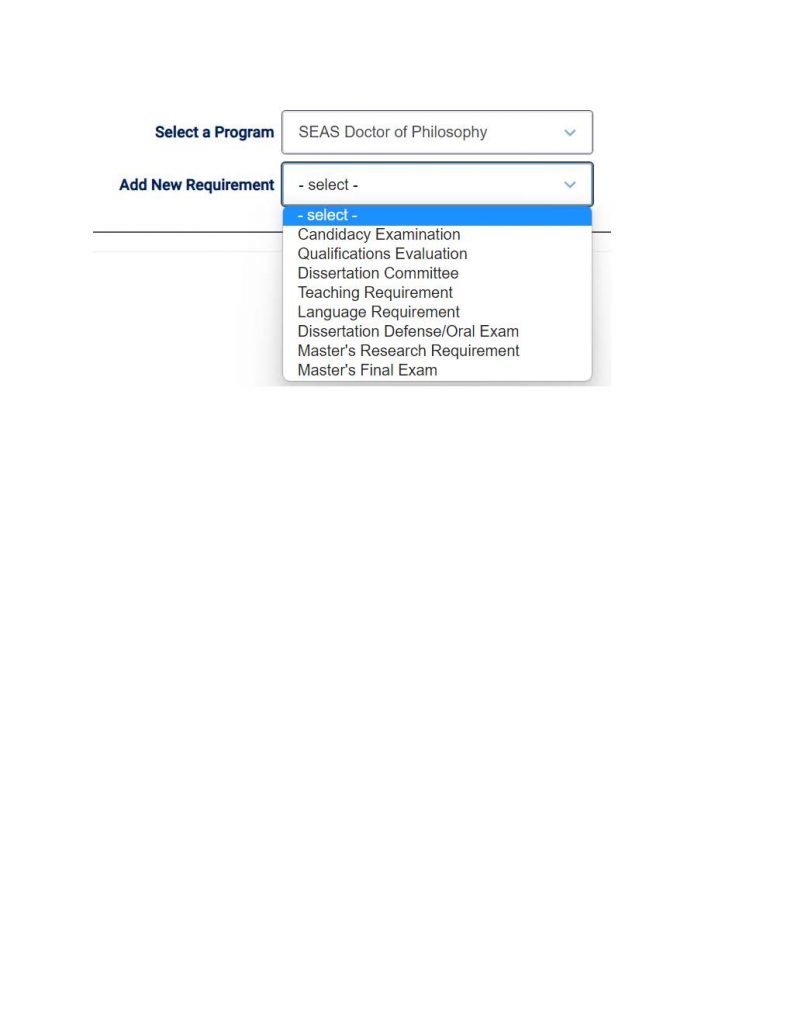
How to submit benchmarks in BP Logix
How to submit benchmarks in BP Logix
Except for CUs, PhD Candidates are required to submit all benchmarks in BP Logix:
- Login to Path@Penn
- BP Logix
- Path Forms
- Scroll down to Penn Graduate Forms
- Fill out the milestone benchmark form
Screenshot of BP Logix Benchmarks:
ESE 8980 Curriculum Practicum Training (CPT)
| Course: | Details: |
| ESE 8980 Curriculum Practicum Training (CPT) | PhD Candidates and Faculty Advisor may agree that an internship at a company would benefit their research. Students and advisors arrange the specifics of the internship. International students must contact ISSS to apply for CPT. *If it is a paid internship, students alert Penn Engineering Financial Services (PEFS) pefs-payroll@seas.upenn.edu as it may affect their PhD Stipend payment. CPT does not count toward full-time status of 3 CUs
For more information on the CPT Process |
EAS 900 Special Training:
|
Course: |
EAS 900 Responsible Conduct of Research in Engineering (RCR) |
| Details: | PhD Coordinator will register first-year students for RCR each fall. Consists of a one-day in-person workshop and an online component. Course does not count toward full-time status of 3 CUs. |
Transfer Credits:
Note: PhD Candidates can transfer up to 9 CUs into their PhD Program. *The course credit, not the course grade, will be transferred in.
| Type of Transfer Credit | Next Steps | Requirements for both Internal and External Transfers |
| Internal (Penn Master’s Degree)
|
Contact your PhD Coordinator only
|
Only courses with grades B or higher are considered
Pass/Fail courses are not eligible for transfer Courses taken under a certificate program, study abroad, or online are not eligible for transfer Transfer credits must be taken prior to matriculation; Penn students cannot be enrolled in 2 schools at once Courses are held to a time limit of 5 years from when the course was first taken. New/incoming students cannot submit transfer requests prior to the semester course selection deadline. Note: graduate courses on an undergraduate transcript will not be considered for graduate transfer credit unless the student was enrolled in an approved accelerated master’s program-no exceptions! |
| External (Master’s Degree outside of Penn) |
Contact your PhD Coordinator then complete the Transfer Credit form
Submit the transfer credit form your Faculty Advisor for their signature. When complete, send form to the Coordinator for Graduate Chair approval. |
See above! |
Transferring undergraduate credits to the PhD transcript:
Students enrolled in the ESE PhD program cannot transfer courses taken at the undergraduate level to their PhD transcript. This includes:
- Students who complete Penn’s Accelerated Masters(submat) program cannot transfer the same courses a third time. The University of Pennsylvania does not allow triple counting courses.
- Students who started an Accelerated Masters (submat) program at the undergraduate level, but leave to pursue the PhD in ESE cannot transfer any courses earned as an undergraduate to either the PhD or completing an MSE during the doctoral program.
There are no exceptions to the above policy.
Dual Graduate Degree
| Guidelines | Available Programs |
| Students interested in increasing their knowledge can apply to dual graduate programs.
Programs entail separate applications and admissions into the two schools, specific curriculum with overlap (double-counting) of courses, and financial aid (if available) Students should speak with their home program/department first Dual-degrees are for on campus programs only For more information Dual Graduate Degree Policies
|
Arts & Sciences: MATH PhD/MSE CIS or CIT
Carey Law: ML/Master’s, JD/Master’s Perlman Medicine: MD/PhD Veterinary: VMD/PhD Wharton: MBA/Master’s, STAT AM/PhD Weitzman Design: MARrch/MSE, MCP/MSE |
Dual Master’s Degrees within Penn Engineering (on-campus)
Students interested in pursuing dual master degrees in Penn Engineering should first talk with their current program, and then the program for which they wish to join as a dual-degree student, after completing at least one semester with a minimum GPA of 3.50. Students need to submit a Dual Master’s Degree Application after talking with both programs, and upload to that application the Proposed Curriculum Guide, and a personal statement explaining why they wish to pursue the dual degree in these programs. Students should submit these materials no later than the course selection deadline (first two weeks or 14 days of a semester) of their final semester. International students looking to apply for a dual degree should not request OPT prior to the outcome/decision of their application. Students must complete a minimum of sixteen (16) course units including up to four (4) course units that satisfy both degree requirements.
A student is only allowed to submit one dual master’s degree application during their master’s studies at Penn Engineering. If a student who has been approved for a dual degree decides to graduate with just one of the two degrees, the student can only drop the later program but not the original program that the student was admitted into. Incomplete applications or those submitted after the deadline noted above will not be reviewed. Those enrolled in Accelerated Master’s are not eligible for a dual-degree as Engineering recognizes matriculation into one Accelerated Master’s program across the schools. Students wishing to pursue a dual degree in the on-campus master’s in Data Science program should apply here too.
Penn Engineering Online students should consult their program for dual degree options.
Leave of Absence
| Leave of Absence (LOA) |
| Students may request a LOA for up to 2 years or 4 academic semesters. Speak with your Faculty Advisor and PhD Coordinator first.
When LOA ends, students must re-apply. Reinstatement is dependent upon departmental and SEAS approval. Students can request a LOA for personal, medical, military, and family leave. Time spent in military service and medical cases do not count under the time limit. Students on leave should remain in contact with their program and provide updates if there are any changes in plans. Requesting a Leave of Absence form Requesting a Return from Leave of Absence form For more information on LOA policies, check the Graduate Handbook |
Withdrawal
| Withdrawal |
| Withdrawing from Engineering may be granted by submitting a Petition for Action. Reinstatement is dependent upon departmental and school approval by applying through the CollegeNet application system. |
Fellowships & Aid:
All Ph.D. students who are in good academic standing are provided with financial aid that covers full tuition, a stipend, and health insurance throughout their program of study in the department. The financial aid is funded by research grants of faculty members, endowments, and other fellowships. The selection process is competitive and is based on merit.
Students can apply to additional Graduate Fellowship Opportunities. Please review the SEAS Graduate PhD Fellowship Policies.
New: To access the 2024-2025: External Fellowship Opportunities